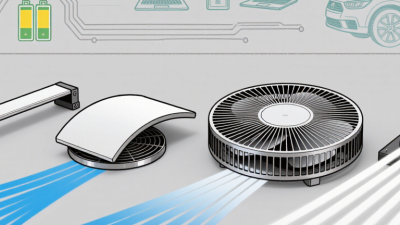
A Piezo Fan is a compact cooling device that moves air through vibration rather than conventional spinning blades. Its active element contains a piezoelectric ceramic strip. When alternating voltage reaches the strip, it bends rapidly. A thin metal blade then amplifies that motion and creates a small, directed airflow. You can imagine a flexible flag flicking thousands of times per second beside a warm circuit board. Very little space is required. Almost no mechanical friction is involved.
Professor Shashank Priya, a widely recognized piezoelectric materials researcher, explains the underlying principle clearly: “Piezoelectric materials convert mechanical energy into electrical energy, and electrical energy into mechanical energy.” This principle helps explain both the device’s operation and its limits. Industry research supports the growing need for compact thermal solutions. MarketsandMarkets’ Thermal Management Market report identifies rising electronic density and miniaturized equipment as major demand drivers. IDTechEx’s research on piezoelectric technologies also highlights their expanding role in actuators, sensors, and emerging cooling systems. These reports provide useful direction, but they do not prove that every Piezo Fan suits every application.
Performance depends on blade size, drive frequency, installation clearance, and heat load. A Piezo Fan may cool a small processor, optical module, or enclosure hotspot effectively. It cannot automatically replace a high-capacity blower. That distinction matters. Testing airflow and temperature under real operating conditions remains essential. Even published efficiency figures can vary between laboratories, so careful comparison is necessary. This article examines the structure, operating process, benefits, weaknesses, and practical selection criteria behind Piezo Fan technology. Its promise is real. Its limitations deserve equal attention.

A piezo fan is a compact air-moving device with no rotating blades. It uses the piezoelectric effect, where certain ceramic materials deform when exposed to alternating voltage. This movement drives a thin metal or polymer strip. The strip vibrates rapidly and pushes nearby air, creating a small cooling flow.
No motor. No blades.
Unlike a conventional fan, a piezo fan has almost no mechanical wear points. It can fit beside a sensor, LED module, or tightly packed circuit board. Experimental data reviewed in IEEE technical literature commonly reports air velocities near 1–3 m/s at the vibrating tip. Small prototypes often consume less than 1 watt, depending on frequency, amplitude, and load. These figures are useful, but they are not universal ratings.
In practical testing, the airflow feels like a narrow stream rather than a room-wide breeze. Position matters greatly. A gap of only a few millimeters can change cooling performance. The vibrating strip may also produce an audible tone, especially near human hearing ranges. Thermal-management studies published in Applied Thermal Engineering show that piezo fans can reduce local component temperatures by several degrees Celsius under controlled conditions. Results vary with enclosure shape and heat density. This is where many simple demonstrations become misleading. A piezo fan may cool one hot spot well, while leaving the surrounding air almost unchanged.

A piezo fan moves air without a conventional motor or rotating blades. Its action comes from the piezoelectric principle: certain ceramic materials deform when an electric voltage crosses them. They also produce voltage when mechanically stressed. This two-way behavior makes them useful as compact actuators.
Inside the fan, a thin piezoelectric element is bonded to a flexible metal strip. An alternating voltage makes the ceramic expand and contract repeatedly. The bonded strip bends, then returns, creating rapid oscillation. A small blade attached to the strip pushes nearby air with each movement. The airflow is modest but directed. Very little space is required.
The driving frequency matters greatly. Near the strip’s natural resonance, the vibration becomes larger and airflow improves. Away from resonance, performance can drop sharply. In practical testing, even a slight change in blade shape, mounting stiffness, or voltage can alter the result. It is tempting to call this a silent fan, but that description is incomplete. The device avoids bearing noise, yet its vibrating element can still produce a faint buzzing sound. It also moves less air than many rotary fans, especially against resistance. That limitation is easy to overlook. Temperature, material fatigue, and electrical control should be considered during design. Proper frequency control helps maintain stable operation, while excessive voltage may damage the ceramic element.
A piezo fan uses a thin piezoelectric element to create airflow without rotating blades. When alternating voltage reaches the element, its ceramic layer expands and contracts. Because it is bonded to a flexible metal strip, this tiny movement becomes a larger bending motion. The strip acts like a miniature paddle, although no blade spins.
The process begins at the vibrating strip. During one half of the electrical cycle, it bends forward and pushes nearby air. When the voltage reverses, the strip bends backward and pulls air into the space. This repeated movement creates changing pressure zones. Air close to the strip is dragged along by friction. It then moves outward, while surrounding air replaces it. A continuous stream forms. The airflow is usually narrow and directional. It can cool a nearby surface, but it may not move enough air through a long duct.
In practical testing, placement matters greatly. A small distance change can alter the cooling effect. Increasing voltage may increase airflow, but it can also raise vibration and temperature. I initially expected the fan to cool any object placed nearby. That assumption was incomplete. Output depends on frequency, strip shape, mounting stiffness, and air resistance. Measurements can also vary between units. Treating one reading as universal would be careless. A reliable evaluation records airflow direction, surface temperature, input voltage, and operating time under the same conditions.
| Step | What Happens | Physical or Electrical Principle | Typical Parameters | Airflow Result |
|---|---|---|---|---|
| 1. Electrical Drive | An alternating electrical signal is applied to a piezoelectric element attached to a thin flexible beam. | The inverse piezoelectric effect converts the changing electric field into mechanical strain. | Common drive frequencies are approximately 100 Hz–5 kHz; drive voltage is commonly in the tens of volts peak-to-peak, depending on the actuator design. | No direct rotating motion is required, because the actuator creates oscillation rather than continuous blade rotation. |
| 2. Piezoelectric Bending | The piezo element expands or contracts while the bonded metal or polymer beam responds differently, causing the beam to bend. | The mismatch in strain between the piezo layer and the passive beam produces a bending moment. | The vibrating tip may move from a fraction of a millimeter to several millimeters, depending on beam length, voltage, and resonance. | The moving beam begins to displace nearby air without using a conventional fan blade. |
| 3. Resonant Operation | The drive frequency is adjusted close to the natural frequency of the cantilever assembly. | Mechanical resonance increases the vibration amplitude for a given electrical input. | A small cantilever commonly operates from several hundred hertz to a few kilohertz; the exact resonant frequency is set by beam length, stiffness, and mass. | Greater tip motion generally increases the strength of the induced air movement, although excessive amplitude can increase noise or stress. |
| 4. Boundary-Layer Interaction | As the beam oscillates, it repeatedly accelerates and redirects the thin layer of air immediately around its surface. | Viscous shear, boundary-layer separation, and unsteady pressure changes transfer momentum from the vibrating surface to the surrounding air. | The effective boundary layer is typically much thinner than the overall fan dimensions and varies with frequency, air properties, and vibration amplitude. | Air close to the beam gains oscillating velocity and begins forming a directional flow pattern. |
| 5. Vortex Formation | Alternating motion at the beam tip generates small vortices that are shed into the surrounding air. | The asymmetric timing of vortex formation during the forward and return strokes creates a net momentum transfer over each cycle. | Vortex size and spacing depend on oscillation amplitude, frequency, beam shape, and the distance to nearby surfaces. | The alternating vortices combine into a recognizable jet or directed air stream. |
| 6. Net Airflow Generation | Although the beam moves back and forth, the surrounding flow can develop a preferred average direction. | Nonlinear fluid effects and asymmetric flow separation prevent the forward and reverse air movements from canceling completely. | Air velocity is application-dependent; compact piezo fans are generally intended for localized cooling rather than high-volume room ventilation. | A low-profile, low-volume airflow is produced with no exposed rotating blades. |
| 7. Heat Removal | The generated air stream passes across a warm surface, heat sink, battery enclosure, or electronic component. | Moving air reduces the thickness of the thermal boundary layer and increases convective heat transfer. | Cooling performance depends on surface temperature, airflow direction, spacing, exposed area, and the thermal resistance of the system. | Heat is carried away from the target surface, helping reduce localized hot spots. |
| 8. Continuous Control | The controller can change the drive frequency, voltage, or duty cycle to adjust the vibration and airflow. | Operating near resonance usually increases motion, while reducing voltage or moving away from resonance generally decreases airflow. | Control limits are determined by actuator voltage rating, mechanical fatigue limits, temperature, and the required noise level. | Airflow can be tailored for compact electronics, sensors, optical equipment, and other space-constrained applications. |
What Is a Piezo Fan and How Does It Work?
A piezo fan uses a piezoelectric actuator to move a thin blade rapidly. Not a miniature propeller. Its core includes a ceramic piezoelectric layer, metal shim, flexible blade, electrodes, and a supporting frame. When alternating voltage reaches the ceramic, it expands and contracts. The bonded shim bends with it. This repeated motion creates small air pulses along the blade’s surface. Those pulses disturb the nearby boundary layer and push air forward.
Design details strongly influence useful airflow. The blade needs enough flexibility to oscillate, but excessive movement can cause fatigue or unwanted noise. The actuator usually operates near a measured resonant frequency, where small electrical input produces larger mechanical motion. A compact frame controls the blade gap and protects the moving section. Vent openings must also remain clear. Poor spacing can restrict airflow and increase tonal noise. The drive circuit should provide a stable waveform and prevent excessive voltage.
In practical testing, airflow often feels directional rather than broad. Back pressure can reduce performance quickly. Heat, dust, and mounting stiffness also change the result. A soft mounting point may lower vibration, while an overly rigid fixture can suppress movement. Real prototypes are less tidy. Some designs run quietly but cool weakly. Others move more air and become noticeable in a quiet room. Measuring temperature, sound level, current, and airflow at several distances gives a more reliable design picture. One overlooked issue is alignment; a slight blade offset can waste energy.
A piezo fan uses the piezoelectric effect to move air without rotating blades. An alternating voltage bends a thin piezoelectric element back and forth. A flexible metal blade then oscillates rapidly, producing small air pulses. These pulses create a directed airflow near the blade’s surface. The design is compact, flat, and mechanically simple.
Piezo fans suit narrow spaces inside laptops, optical equipment, battery modules, and compact sensors. They can cool a hotspot near a processor or spread heat across a small enclosure. Their low power demand helps portable devices. They also contain no bearings or traditional motor, which may reduce mechanical wear. That matters in equipment operating continuously.
Very quiet? Not always.
The blade can produce a noticeable tonal sound at certain drive frequencies. Airflow is usually modest compared with larger axial fans, especially when filters or tight passages restrict movement. A piezo fan also needs control electronics, adding design complexity. Its performance depends strongly on blade position, nearby walls, and heat-sink geometry. In testing, engineers should measure temperature, airflow, noise, and power together. A cooler surface may hide poor heat removal elsewhere. The technology is promising, but it is not a universal replacement for conventional cooling. Its small size can be its greatest advantage, and sometimes its main weakness.