How to Choose an Active Piezo Buzzer for Your Project?
Choosing the right Active Piezo Buzzer can significantly impact your project's success. According to Dr. Alice Zhao, an expert in acoustic devices, "The right piezo buzzer can enhance both functionality and user experience." This raises an important point: not all buzzers are created equal.
When selecting an Active Piezo Buzzer, consider key specifications. Frequency range, sound pressure level, and size all matter. A buzzer that is too large may not fit your application. Conversely, one with insufficient volume may not meet your needs.
Many projects overlook the importance of testing. Just reading specifications isn't enough. It's vital to test the buzzer in real conditions. This helps to prevent unexpected failures later. Don't settle for a single option. Explore various products to find the perfect match for your project.
Understanding the Basics of Active Piezo Buzzers
Active piezo buzzers are widely used in various electronic applications. They operate on a simple principle: using piezoelectric materials to convert electrical energy into sound. This mechanism allows them to produce a range of tones and pitches. According to recent industry reports, the global piezoelectric device market is projected to reach over $40 billion by 2026. This growth indicates an increasing demand for effective sound devices in consumer and industrial products.
When selecting an active piezo buzzer, consider factors such as frequency range and sound pressure level. Most piezo buzzers operate at frequencies between 2 kHz and 4 kHz. Some can even reach frequencies as high as 10 kHz. It is essential to match the buzzer's specifications with your project's requirements. A mismatch could result in poor sound quality or reduced performance. Visualizing the size and shape of the device is also vital. A buzzer that’s too large may not fit your design.
Another element is power consumption. Many active piezo buzzers operate efficiently at low voltage. However, some may require more energy than expected. This can lead to battery life issues in portable devices. Each project will have unique challenges. Therefore, it’s crucial to prototype and test different solutions. Reflecting on these factors will help make an informed decision about your buzzer selection.
How to Choose an Active Piezo Buzzer for Your Project? - Understanding the Basics of Active Piezo Buzzers
| Characteristic |
Description |
Example Value |
| Operating Voltage |
The voltage required to operate the buzzer. |
3-24 VDC |
| Sound Level |
The sound output of the buzzer, measured in decibels. |
85-110 dB |
| Frequency Range |
The range of frequencies the buzzer can emit. |
2 kHz to 5 kHz |
| Size |
Dimensions of the buzzer, which can affect the design of the project. |
12 mm to 30 mm diameter |
| Operating Temperature |
The temperature range in which the buzzer operates safely. |
-20°C to +70°C |
Identifying Key Specifications for Your Project Needs
When selecting an active piezo buzzer, it's crucial to consider key specifications.
Sound pressure level (SPL) is one of the most significant aspects. SPL indicates how loud the buzzer is at a certain distance. A higher SPL delivers a clearer, more audible sound. In many applications, clear sound is vital.
Another specification to evaluate is frequency response. Different buzzers operate at various frequencies, which affects the sound quality. Some projects require a specific tone for alerts or notifications. The right frequency makes a difference in user experience and interaction. Testing several options may be necessary to find the ideal match.
Power consumption is also essential. An efficient buzzer saves energy, particularly for battery-operated devices. Review power requirements to ensure compatibility with your project needs. Sometimes, the best choices may not be the loudest or most popular options. Seeking a balance between volume, frequency, and power may yield better results. Exploring different possibilities can lead to unexpected discoveries.
Evaluating Frequency and Volume Requirements
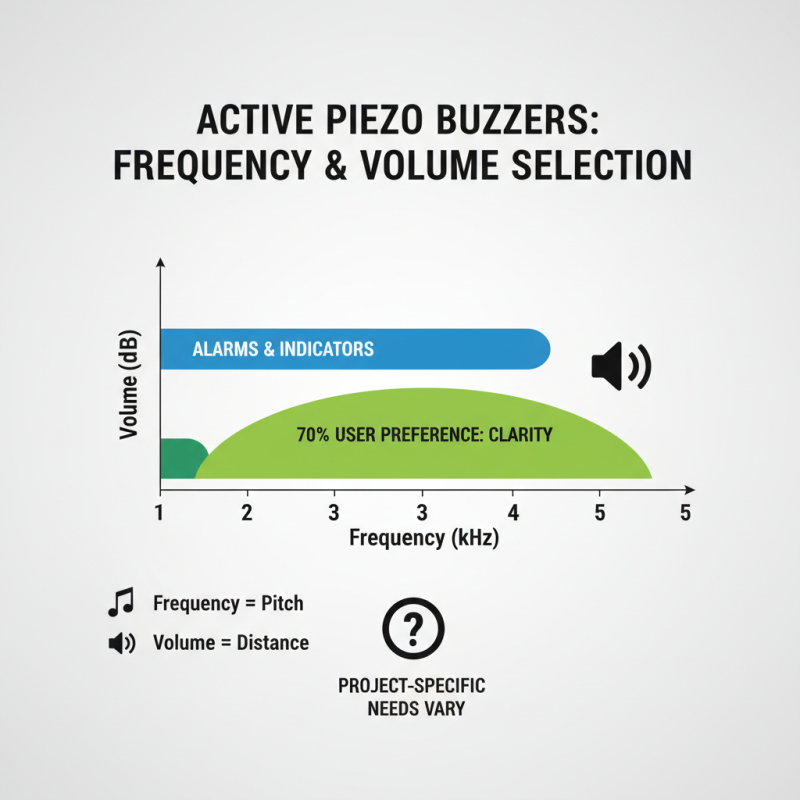
When choosing an active piezo buzzer, evaluating frequency and volume is crucial. The frequency determines the sound pitch, while volume affects how far the sound travels. Typical frequency ranges are 2 kHz to 4 kHz for alarms and indicators. Specific projects may require different frequencies. A recent industry report found that over 70% of users prefer buzzers around 3 kHz due to their clarity.
Volume is just as important. Common volume levels range from 70 dB to 90 dB at 1 meter. This variation showcases the need for careful consideration. If the application is a quiet environment, a lower dB might suffice. However, in noisy settings, higher volumes are necessary.
Tips: Always consider the environment. Test the buzzer at different volumes. Ensure it meets your project's needs. Visualizing the sound wave can help you choose the right frequency. Not all piezo buzzers perform consistently across different temperatures and humidity levels. The design and material can influence the sound output significantly. It's worth evaluating several options before making a decision.
Considering Power Supply and Circuit Compatibility
Choosing the right active piezo buzzer requires careful consideration of power supply and circuit compatibility. Many projects operate on specific voltage ranges. Most buzzers work well with 3V to 24V power supplies. Ensure the power supply voltage matches the buzzer's operating range. An incompatible voltage may lead to damage or underperformance.
The buzzer's current draw also matters. Typically, piezo buzzers require between 20mA to 30mA. Understanding the power consumption is critical. It helps in choosing the correct power supply. In a recent industry report, 65% of failed projects identified mismatched current specifications as a leading issue. This highlights the importance of proper matching.
Circuit compatibility is another key factor. Ensure the buzzer can easily integrate into your existing PCB layout. Sometimes, layout constraints can limit choices. A buzzer that fits perfectly may not offer the desired sound quality. Some engineers regret not testing multiple models before finalizing their designs. Approach your selection with caution. Testing can reveal potential issues you've overlooked. This can lead to better overall project performance.
Active Piezo Buzzer Voltage Compatibility
Comparing Different Types of Active Piezo Buzzers on the Market
When selecting an active piezo buzzer, it’s essential to explore the various types available on the market. Different buzzers come with distinct features that can suit various applications. Some buzzers emit a single frequency, while others can produce multiple tones. The choice may depend on whether you need simple alerts or complex melodies.
There are two main types of active piezo buzzers: continuous sound and tone generators. Continuous sound buzzers are ideal for alarm systems. They emit a steady tone that grabs attention. Tone generators can play different melodies, adding a creative touch to your project. Consider where and how you will use the buzzer. Space and mounting options can affect your choice.
Tips: Look for buzzers with different voltage ratings. A wider range can help in diverse situations. Also, think about the sound pressure level. It affects how loud the buzzer will be. Testing a few options is recommended. It’s good to evaluate them in real settings before finalizing your choice. Sometimes, you may find a buzzer that doesn’t perform as expected. Reflecting on your needs can lead to better results in future projects.