Selecting the right Piezo Technology supplier can determine whether a sensor survives testing or fails in the field. The decision extends beyond price, voltage range, and catalogue size. It requires evidence from materials, manufacturing, validation, and technical support.
Industry forecasts show why this choice matters. MarketsandMarkets’ Piezoelectric Devices Market report estimated the sector at approximately USD 22.3 billion in 2023, with continued growth expected through 2028. Grand View Research also reports strong expansion, although market estimates differ by application and product definition. That difference deserves attention. It shows why buyers should verify assumptions instead of trusting one headline figure.
A capable supplier should provide measured data, not attractive promises. Ask for frequency-response curves, displacement tolerance, fatigue results, and batch-level traceability. For medical projects, review relevant IEC 60601-1 controls. For automotive applications, examine IATF 16949 practices and qualification evidence. ISO 9001 certification supports process discipline, but it does not prove every actuator will meet your design.
Look closely at the factory details. Can technicians identify the ceramic lot used in a failed component? Are bonding layers inspected after thermal cycling? Does the supplier offer engineering samples before mass production?
A polished brochure is not enough.
Supplier experience also matters when the design changes. An expert partner should explain resonance shifts, preload effects, humidity risks, and cable limitations in plain language. Independent laboratory results can strengthen confidence, but they may not represent your exact operating conditions. That is an uncomfortable limitation.
The best selection process combines report-based market awareness with direct technical verification. It may take longer. However, one careful audit can prevent months of redesign, field returns, and uncertain performance.
Choosing a piezo technology supplier starts with defining the application, not comparing catalog prices. Describe the motion, force, frequency, duty cycle, and environment in measurable terms. A valve may need a 20-micrometer stroke, while an ultrasonic transducer may require stable operation above 1 MHz. These are different engineering problems.
Set performance targets before requesting quotations. Record voltage limits, displacement tolerance, response time, hysteresis, lifetime, temperature range, and permissible vibration. The U.S. Department of Energy’s Solid-State Lighting Technology reports show how efficiency targets can reshape component selection; piezo systems need the same discipline. MarketsandMarkets’ Piezoelectric Devices Market report forecasts continued growth through 2028, driven by sensing, medical equipment, and industrial automation. Demand alone does not prove suitability.
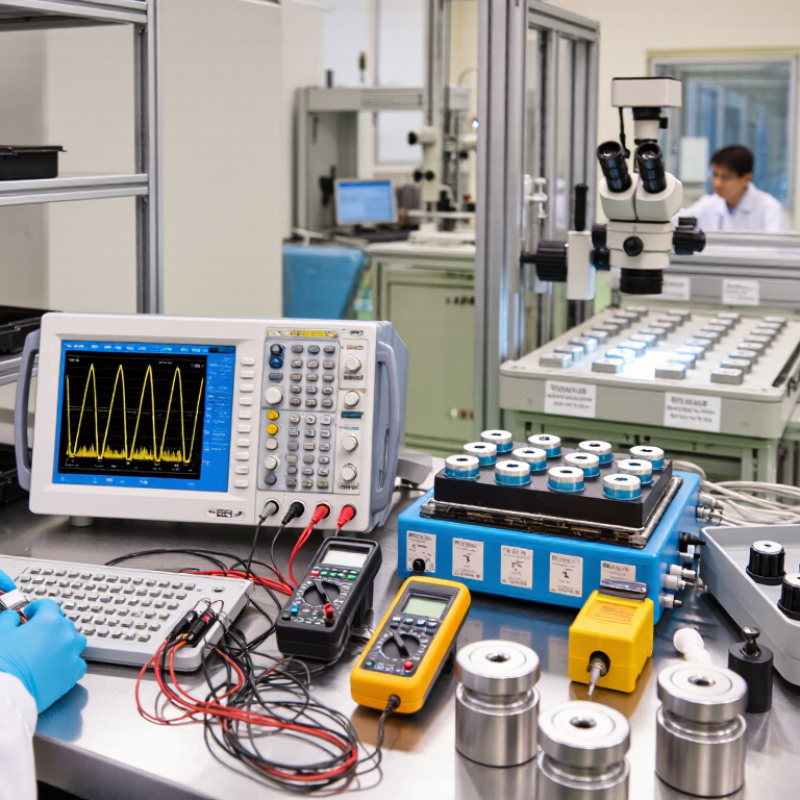
Ask suppliers for test conditions, not only headline specifications. Request impedance curves, fatigue data, thermal results, and sample-to-sample variation. A supplier should explain how performance changes after one million cycles or near resonance. Small details matter. Connector layout can affect noise. Adhesive choice can change stiffness.
A useful requirement sheet includes real operating waveforms and failure limits. It should also separate essential goals from convenient preferences. This part is often underestimated. In early projects, teams may specify peak displacement but forget settling time or preload. That mistake can produce a device that moves correctly but responds too slowly. Review the assumptions with an independent engineer when possible, and leave room for revision when testing challenges the original plan.

How to Choose the Right Piezo Technology Supplier?
Compare Piezoelectric Technologies for Your Intended Use
Compare the material to the task, not just the supplier’s catalogue. Bulk ceramic elements usually provide strong displacement and high electromechanical coupling. They suit ultrasonic tools, valves, and vibration control. Single-crystal materials can deliver greater sensitivity, but they often cost more and require tighter temperature management. PVDF polymer is flexible and lightweight. It works well for wearable sensors, impact monitoring, and curved surfaces, although its output is generally lower.
Thin-film piezoelectric layers support compact MEMS devices and fast manufacturing. However, their performance can change with deposition quality and substrate stress. According to Grand View Research’s 2024 Piezoelectric Devices Market report, the market was estimated at more than USD 30 billion in 2023, with growth forecast through 2030. That expansion covers very different applications, so one technology cannot serve every design.
Ask suppliers for measured d33, dielectric loss, resonance frequency, fatigue data, and temperature limits. Request test conditions, not isolated headline values. I have seen teams choose high displacement, then discover poor repeatability after thermal cycling. That mistake is expensive. Supplier credibility depends on traceable calibration, lot-to-lot data, and engineering support during prototyping. Review sample performance in your actual housing, adhesive, drive voltage, and duty cycle. Catalogue data can look perfect. Real assemblies are less forgiving.
| Piezoelectric Technology | Typical Material | Main Advantages | Key Limitations | Typical Operating Temperature Range | Relative Electromechanical Performance | Typical Applications | Best Fit When You Need |
|---|---|---|---|---|---|---|---|
| Lead-Based Ceramic | Lead zirconate titanate ceramic | High piezoelectric coefficients, high dielectric constant, strong actuation force, mature processing, and broad availability in many geometries. | Contains lead, relatively brittle, and performance decreases as the material approaches its Curie temperature. Requires careful mechanical and electrical design. | Approximately -40°C to 150°C for many standard grades; the exact limit depends on composition, poling, and design. | High displacement, coupling, and sensitivity compared with most conventional piezoelectric materials. | Ultrasonic transducers, actuators, precision motion systems, buzzers, pumps, valves, and vibration control. | Maximum output, strong force, high sensitivity, and a well-established ceramic manufacturing process are priorities. |
| Lead-Free Ceramic | Alkali-niobate, bismuth-based, or related lead-free ceramic systems | Reduced concern regarding lead content, compatibility with environmental initiatives, and useful actuator and sensor performance. | Performance and temperature stability vary significantly by formulation. Processing windows, aging behavior, and long-term supply consistency may require additional qualification. | Commonly approximately -20°C to 100°C, although specialized formulations can differ substantially. | Moderate to high; generally competitive for selected applications but not uniform across all formulations. | Consumer products, environmentally sensitive equipment, industrial sensors, actuators, and research devices. | Lead reduction is a major requirement and the application can be qualified for the selected formulation and operating range. |
| Piezoelectric Single Crystal | Relaxor-ferroelectric single crystal | Very high coupling, high strain, excellent sensitivity, and strong performance for demanding acoustic or precision-actuation designs. | More fragile and expensive than conventional ceramic, sensitive to depoling and temperature, and available in fewer shapes and sizes. | Often approximately -20°C to 80°C; the usable range depends strongly on crystal composition, orientation, and bias conditions. | Very high coupling and sensitivity, with excellent performance in optimized designs. | Medical ultrasound, high-performance sonar, precision actuators, energy harvesting, and advanced acoustic systems. | Peak sensitivity, bandwidth, or displacement is more important than cost, ruggedness, or broad temperature capability. |
| Piezoelectric Polymer Film | Polyvinylidene fluoride and related fluoropolymer films | Flexible, lightweight, impact-resistant, conformable, easy to laminate, and capable of covering large areas. | Lower piezoelectric coefficients and dielectric constant than most ceramics; limited stiffness, temperature capability, and high-force actuation. | Typically approximately -40°C to 80°C, with the exact limit depending on polymer type, processing, and electrodes. | Low to moderate coefficient and coupling, but excellent flexibility and dynamic sensing capability. | Wearable sensors, contact microphones, vibration sensing, flexible switches, structural monitoring, and impact detection. | Flexibility, low mass, conformability, or large-area sensing is more important than maximum force or displacement. |
| Piezoelectric Composite | Ceramic elements embedded in a polymer matrix, commonly a 1-3 or 2-2 structure | Combines ceramic sensitivity with lower acoustic impedance, improved mechanical compliance, broad bandwidth, and easier acoustic matching. | More complex to manufacture, can absorb moisture or age through the polymer phase, and may have lower mechanical robustness at elevated temperature. | Commonly approximately -20°C to 100°C; the polymer matrix often determines the practical limit. | High acoustic performance with favorable bandwidth and matching characteristics. | Ultrasound imaging, non-destructive testing, hydrophones, sonar, and specialized medical transducers. | Wide bandwidth, acoustic matching, and lower impedance are required for a transducer operating in liquids or soft materials. |
| Piezoelectric Thin Film | Aluminum nitride, zinc oxide, or thin-film lead-based ceramic | Very small size, high-frequency operation, wafer-level fabrication, low moving mass, and potential integration with electronic circuits. | Limited film thickness and displacement, lower low-frequency force output, deposition-quality sensitivity, and specialized manufacturing requirements. | Often approximately -40°C to 150°C, depending on the deposited material, substrate, electrodes, and packaging. | Low to moderate bulk displacement, but excellent suitability for high-frequency microsystems. | MEMS resonators, micro-pumps, filters, microphones, timing devices, and integrated sensors. | Miniaturization, high frequency, wafer-level processing, and integration with semiconductor manufacturing are essential. |
| Quartz | Natural or synthetic quartz crystal | Excellent frequency stability, low hysteresis, low aging, high quality factor, and reliable operation in resonant circuits. | Low piezoelectric coefficients, limited actuation force, relatively small strain, and sensitivity to crystal orientation and mounting. | Commonly approximately -55°C to 125°C in packaged devices; specialized designs can extend beyond this range. | Low actuation and sensitivity, but very high frequency stability and quality factor. | Frequency references, oscillators, timing systems, precision sensors, and measurement instruments. | Frequency stability, low drift, and repeatable resonance are more important than large displacement or high output force. |
| High-Temperature Piezoelectric Ceramic | High-Curie-temperature ceramic compositions | Better resistance to depoling and performance loss at elevated temperatures than standard ceramic grades. | Usually offers lower room-temperature coefficients or higher drive requirements than optimized general-purpose ceramics; thermal cycling must be evaluated. | Approximately 150°C to 350°C for selected materials and designs; the practical limit depends on the Curie temperature, electrodes, and packaging. | Moderate to high, with emphasis on temperature endurance rather than maximum room-temperature output. | Engine monitoring, aerospace sensing, downhole tools, combustion monitoring, and industrial process control. | Stable piezoelectric operation at elevated temperature is required and the design can tolerate specialized materials and packaging. |
Note: Temperature ranges and performance levels are representative engineering guidelines, not guaranteed specifications. Final selection should be based on the supplier’s measured data for the exact material grade, geometry, electrodes, preload, drive conditions, aging behavior, and environmental qualification.
How to Choose the Right Piezo Technology Supplier?
Supplier expertise should be tested through evidence, not polished presentations. Ask for application records covering frequency, displacement, voltage, temperature, and fatigue limits. A capable engineering team should explain failure modes in plain language. They should also show how prototypes become repeatable production parts.
Manufacturing discipline matters just as much. Review ceramic formulation controls, electrode deposition, bonding, polarization, and final calibration. Request process capability data for critical dimensions and electrical output. The 2024 Grand View Research report estimates the global piezoelectric devices market will expand at about 6.9% annually through 2030. That growth increases pressure on capacity and consistency. ISO’s 2023 Survey recorded more than 1.26 million ISO 9001 certificates worldwide. Certification helps, but it does not replace a site audit. Check lot traceability, equipment calibration, corrective-action records, and aging-test results. A perfect file can still hide weak production habits. That is worth challenging.
Tips: Ask for three recent batch records. Compare promised tolerances with measured data. Inspect storage conditions for ceramics and adhesives. Confirm whether testing uses calibrated instruments. Review how nonconforming parts are contained and investigated. If the supplier refuses reasonable technical questions, pause the evaluation. I would also require a pilot run before approving volume production. It may delay purchasing, but one missed drift problem can cost far more. Industry reports provide useful market context; factory evidence should drive the final decision.
Choosing a piezo technology supplier starts with the application, not the catalogue. In supplier audits, I look for evidence before promises. Fortune Business Insights’ 2024 Piezoelectric Devices Market report valued the global market at about USD 31.9 billion in 2023. That scale hides differences in materials, tolerances, and production maturity. Ask for drawings, material data, frequency response, aging results, and a clear change-control process. Customization should cover geometry, electrodes, encapsulation, drive electronics, and mounting. It should not mean only a revised quotation. Ask harder questions.
Testing must mirror the real assembly. Request impedance curves, displacement or force data, thermal cycling, humidity exposure, fatigue results, and lot-to-lot variation. IEEE 176 offers useful terminology and measurement foundations, but application testing needs more than laboratory numbers. A supplier should explain fixtures, calibration, sample size, acceptance limits, and failed units. Test it twice. If reports show only best-case results, reliability claims remain weak. A supplier may pass a test and still miss the application.
Support and supply capability decide whether a prototype becomes a product. Review response times, technical ownership, traceability, second-source planning, lead-time history, and capacity during demand spikes. The Federal Reserve Bank of New York’s Global Supply Chain Pressure Index has recorded sharp logistics swings in recent years. Ask for realistic forecasts, safety-stock options, and written process-change notifications. I still leave room for doubt: polished audits can miss small communication failures. Visit the production line when possible. Listen to operators. Silence is expensive.
How to Choose the Right Piezo Technology Supplier?
Select the Supplier Offering the Best Technical and Commercial Fit
The right supplier must understand your application, not only your component list. Share operating frequency, displacement, drive voltage, temperature range, and mounting limits. A supplier with practical engineering experience will ask about load, humidity, vibration, and duty cycle. These details often reveal hidden design risks.
Request test samples and inspect measured results against published specifications. Check tolerances, aging data, insulation performance, and response consistency across production batches. Ask how the supplier controls materials and verifies each shipment. Clear drawings, traceability records, and realistic failure data show technical maturity. Marketing language alone does not.
Commercial fit matters just as much. Compare minimum order quantities, tooling charges, lead times, payment terms, and production capacity. Ask whether the supplier can support prototype quantities without disrupting future volume orders. A low unit price may become expensive when delivery slips or redesigns begin. I once treated a shorter lead time as the best advantage. That view was too narrow. The samples needed extra testing, and the delay moved elsewhere. A useful supplier should explain limitations openly, respond with evidence, and offer a practical path from prototype to stable production. Getting this balance right can take several conversations. That is normal.
Select the supplier offering the best technical and commercial fit
The evaluation model prioritizes application performance, manufacturing capability, quality assurance, customization, supply continuity, total cost, and technical support. A strong supplier should achieve a balanced result across both technical and commercial requirements rather than scoring highly in only one area.
Scores are normalized from 0 to 100 using a typical industrial piezoelectric component selection framework; final weighting should be validated against the application’s voltage, frequency, temperature, lifetime, volume, and qualification requirements.